Saturday, April 9, 2011

Asperger's Acceptance and Disclosure—What's the Difference?

I just read a father's perspective on acknowledging that his son has Asperger's. I recommend it, as I recommend most first-person, authentic perspective about AS.

Eventually, we either spend the energy to accept and live with Asperger's, or we spend the energy to deny and live with Asperger's. Both are draining, but one drains us in partnership with the truth, and one drains us by forcing us to repress/suppress the truth.

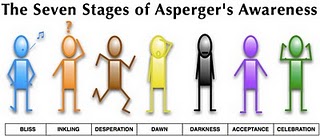
As I detailed in my series on the Seven Stages of Asperger's Awareness, acceptance is a precursor to disclosure. Acceptance is telling the truth to yourself. Disclosure is telling the truth to others. How much of the truth you tell to others should be a function of need and intimacy, but how much you tell yourself should only be limited by what you can handle.

As with many things, premature or over-disclosure can be traumatic But if you are having trouble disclosing to yourself (accepting your diagnosis) you should seek counsel with a friend, family member or professional.

The Seven Stages of Asperger's Awareness—Complete List

From ignorance to embracing—accepting Asperger's is a process.

Seven Stages Overview

I have received a lot of positive feedback about my series on the stages of Asperger's awareness.

Note: This is NOT Tony Atwood's four stages of diagnosis acceptance—which may not exist anyway...

Here are the 8 sections collected in one place.

The Seven Stages of Asperger’s Awareness: Background

Bliss: The first stage of Asperger’s Awareness

Inkling: Stage Two of Asperger's Awareness

Desperation: The Third Stage of Asperger's Awareness

Dawn: The Fourth Stage of Asperger's Awareness

Darkness: The 5th Stage of Asperger's Awareness

Acceptance: The Sixth Stage of Asperger's Awareness

Celebration: The Seventh Stage of Asperger's Awareness

Monday, April 4, 2011

Teaching an Aspie to Drive: #1 Driving with Purpose for Safety and Efficiency

Should people with Asperger's be allowed to drive?

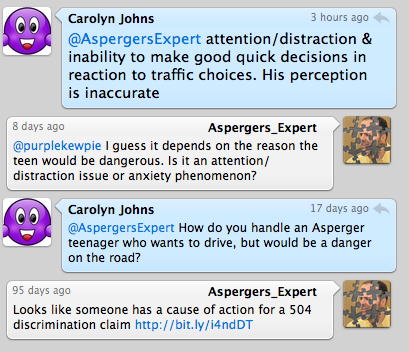
I responded to a twitter question and had the following exchange:

AspieDrivingTweets

So the real answer needs more than 140 characters.

I think I'll divide this up into 3-4 posts.

Here's my take.
1. People with Asperger's are people, and the default should be that they have the standard suite of rights and privileges of adults—including the privilege of driving.
2. People with Asperger's have a complicated constellation of challenges that make driving a differently challenging task. I don't say harder, but there isn't really a standard I can reference.
3. If some of the challenges for an individual with Aperger's are related to other kinds of challenges we face, then we can assess and adjust to help them be safe and confident drivers.
4. Driving is a privilege. Driving is a privilege. Driving is a privilege. Safety earns that privilege. Unproven confidence doesn't earn the privilege.


PURPOSE: What is the purpose of driving?
For some of us, driving is utilitarian. We just want to get from A back home to A safely and efficiently. For others, driving is a sports event, a statement of independence or adulthood, a personal therapy session, a time to lecture kids as a captive audience, or a form of mobile flirting. I'll bet I don't have to describe all the types of drivers for you to recognize our varying purposes.
For an Aspie learning to drive, the first thing I would do is define the purpose. I would limit the purpose to utilitarian transportation—both safe and efficient. Limiting the purpose let's you as the driving instructor put a lot of other behaviors off-cue.

Defining the purpose also helps define success. Making sure that the outcome is clearly defined and prioritized is important. Safety is vastly more important than efficiency. If you are in the wrong lane to enter an on-ramp or make a turn, efficiency would urge you to make a challenging and less-safe maneuver to keep on your preferred/efficient route. Safety says, go around, make a u-turn, recalculate the route or find a safe place to reset and recalculate. Safety is number 1-9, efficiency comes in #10 and every other purpose is really a dangerous non-purpose.


When teaching an Aspie to drive, use the cognitive and metacognitive abilities of the Aspie to help shape the thought process of driving to be safety oriented. For example, when teaching my son, I had him think out loud so I could hear him verbalize his observations. By affirming the safety-oriented thoughts and helping his filter out the non-safety oriented thoughts I was able to help him be more focused on safety factors and less distracted by signs, environment, cars, other drivers, etc. Helping the driver learn to ignore stimuli is critical. For an Aspie with hypervigilant senses, ignoring is more important than noticing. The Aspie will probably note everthing. The key is learning what to notice and give extra attention.

In the next post I'll address some Protocols for driving safely. I'll touch on things like literal and mental blind spots, status quo as safety, and the specialized language used for communicating with other drivers.

Stay tuned after that for posts including Perceptions and Programs.

Safe travels!


Tuesday, March 29, 2011

Avoid, Ignore, Adjust

23 SeeHearSpeakNoEvil image via kaykays.com

It's irritating.

I don't know what it is. It might be a person, a ticking clock, a fabric texture, a smell, or anything else that set's you off. You can't control the initial stimulus, and you can't be your best self while the irritant is present.

What to do?

A—I—A

There are at least two layers to this problem. First, the stimulus itself is a problem. The sensation or interaction is having a disproportionate impact on your ability to practice self-control. You live in a society that values self-control and in a natural world that offers all sorts of organic punishments for losing control.

Let me share some examples.

  • While driving a car, bright sunlight flashes off keys or a water bottle.
  • Still driving, you realize that a bee, moth, or fly is in the car with you.
  • While waiting for an interview, you smell something that makes you crazy.
  • At a theater, you can't shut out the ticking sound of the projector.
  • While taking an important entry exam, the flickering fluorescents interfere with your concentration.

Second, your reaction to the stimulus is a problem. You can't stop thinking about it so the irritation feeds on itself in a crescendo of irritation that leads to a meltdown, shutdown, or blowup. Because you can't manage your response to the irritation you lose composure and lose the chance to perform at your best.

You can deal with both problems, but not without advance planning.

AVOID—As we get older and more autonomous, we have more choices and freedom to plan our life and times. My son is starting college next fall. He has made the decision to request an individual room in one of the dorms. This gives him a lot of interaction with the college community, but also preserves his need for an oasis of controlled environment. You might have a specific irritant that you can avoid. I struggle with bright light, especially diffused light. When I walk into a meeting, restaurant, or library I am very conscious of facing away from the brightest light in the room. I sit with my back to the window if possible and face into a dark space when I can. I wear sunglasses and a brimmed hat when I can. When driving, I sometimes put clip-on lenses over standard sunglasses to get an extra dark function. No matter what the irritant is, if you know it's coming and you can avoid it that's more than half the battle.

IGNORE—It helps to know your options. Is this irritant something you can ignore? If it's a sound, can you put in earplugs, listen to music, introduce white noise or create some appropriate sound yourself? If it's a visual stimuli, do you have the option of covering your eyes, setting up a visual barricade, or changing your direction of view? Ignoring and overriding the irritant is usually the low-cost option. Even smells and textures can be managed with some advance planning.

Most of us know our triggers, so planning strategies and having simple equipment to support ignoring is a viable strategy.

ADJUST—Strangely, the most empowering strategy for us on the spectrum is one we are most hesitant to use. Adjusting the stimulus is often simply a matter of taking the initiative to close the blinds, turn down the volume, request a different table, or ask someone to stop a behavior. The problem is that people with Asperger's have a double bind when it comes to adjusting stimuli. We don't have great intuition and social skills—especially for asking others to change their behavior. We hesitate to "impose" our preferences or "intrude" on someone else's situation. That's one reason why it's important to learn how to make requests using "I" statements. It is much more socially acceptable to say, "I can't concentrate with that music playing, could you turn it off please?" than to say, "Turn that down!" I've found that most of the time the irritating condition is not anyone's priority, it's just a status quo or mild preference.

When you have Asperger's, the world is a multiple-bogey environment filled with potential and actual irritants. How you preempt or adjust to the crazy-making stimuli can be the difference between performing at your best or losing composure and opportunities.

If you are or are raising an Aspie, teach yourself or your child to remember A—I—A

Wednesday, February 2, 2011

Square Pegs

large-go-button.jpg

I got expelled from seminary.

To be accurate, I was gently encouraged to leave.
I didn't do anything wrong; and neither did the seminary.

I had already been teaching for awhile, but there was a splinter in my brain (that sounded a lot like my mother :-) insisting that I should be a pastor.
After a year of study, several theology classes and a mind-numbing sojourn into Koine Greek, I sat down with my advisor. He talked me through a set of interest inventories I had completed. He asked me pointed questions about my heart for different aspects of ministry.

Near the end of our conversation, he said, "Peter—you should not be a pastor. God has made you a teacher. Go and teach well."

I have learned a lot since that conversation in 1991. Mostly I have learned to retroactively appreciate the gracious release from a dream that wasn't really mine. I've learned that I was built to lead through challenging, questioning, explaining and inspiring. Those could have been good pastor-teacher qualities, but I lacked the nurturing, comforting, and caring impulses that make the best pastors minister effectively.

A lot of our students need someone to pull the college splinter from their brain.
A lot of our students need to be told graciously and lovingly that "college is a round hole and you are a beautiful trapezoid. Go be a chef, a designer, a builder, a painter. Harvest lumber, care for children, build a life with your hands and your heart. Let the people who live in their heads thrive at college. You go and live in the world of people and things."

A new report from Harvard University backs me up.
Let's expel students from the falsely universal expectations of college and some high school programs as well.
Let's release them to a different kind of greatness.


Monday, January 10, 2011

Eat like an Aspie

As a child, there were some foods I could not eat. I wasn't stubborn. In fact, I was fairly adventurous, but some foods were inedible because of texture or taste quirks. For example, I remember cheese being very hard to eat, especially the overly smooth texture of processed cheese. (I still consider Velveeta, Spam, and Miracle Whip the unholy trinity of food-like products.)

Anyway, if you are raising an Aspie like me, you might appreciate some practical tips from the Happy Housewife. Although not directed towards those who manage spectravores, it does have some smart and specific tips for making it through the food wars.

Thursday, December 30, 2010

Will I have Asperger's in heaven? Yes.

I had a little fun with this question recently by polling several Aspies and their parents. I left the question closed—as a yes-no question. That didn't stop anyone from answering with gusto and applying the answer to their own experience.


Not surprisingly, the trend was that parents experienced Aspergers as a condition/disability that will go away, while Aspies themselves see Aspergers as something that is part of their identity.


Background:

I am a Christian believer in the historical, biblical tradition. I am part of a congregation in the Evangelical Covenant Church which means I affirm basic tenets of Christianity including:


I believe:


•There is an eternal, relational God existing in three co-equal persons—Father, Son, & Spirit.

•God is the standard for morality.

•All humans fall short of God's standard—we call this deficit sin.

•The gap between God's standard and human sinful behavior separates us from God.

•We can't bridge the gap through our own effort or righteousness.

•God offered a bridge in the person of his own son Jesus.

•Jesus is both a real historical person and a divine person of the triune god.

•Jesus willingly accepted responsibility for my sin and yours, dying a substitutionary, sacrificial death by execution on a cross.

•God the Father raised His Son from true physical death—adding "Savior" to his eternal title as Lord of the Universe.

•As Lord and Savior, Jesus' death and resurrection broke the power of sin and death.

•In his sacrifice, Jesus offers each of us individual salvation that can restore us to a right relationship with God.

•Because God loves us and grants us true free will, salvation is not mandatory—we can accept it or reject it.

•Following his resurrection and ascension, Jesus sent a third person of the trinity—the Holy Spirit—to give us power to live in relationship with God.

•Accepting Jesus' offer of salvation is the way to experience eternity in God's presence—what Jesus called "paradise" in his words to the thief who was crucified with Him.

•What Jesus called paradise we commonly call heaven. It is the time/place/condition of eternal fellowship with a personal God and fellow saved believers.

•The doors to heaven are open to all, but God sets the conditions for admittance. His condition is acceptance and commitment to Jesus the Christ.


As I understand them, these beliefs are an important part of the good news that Christians call the gospel. I am probably leaving some things out, but in order to understand what I say about heaven you need to know what I mean.


Implications:

The list above is more doctrinal. Here are several implied or practical believes.


Truth is truth. Even if you disagree with every doctrinal point I made above, you may find some insightful truth about Asperger's Syndrome on this blog. I trust my expression of personal faith will not disqualify me in your eyes, but I take that risk willingly.


Asperger's is no respecter of faith. Being a Christian, Muslim, _________________, doesn't exempt or subject you to Asperger's any more than faith protects you from an earthquake. "The rain falls on the righteous and the unrighteous alike."


So, "Will I have Asperger's in Heaven?" demands a very granular response. I would expect a wide range of answers from my Buddhist, Catholic, Muslim, Atheist, and other friends—just as I hear a wide range of answers within my congregation and family. My answer is only my answer. My wife and son don't agree with me on all points. We are—none of us—monolithic.


Conclusion:

My answer is yes. I will have Asperger's in heaven.


There are aspects of Asperger's that help me relate to others and to God. My personal theology is that those elements will persist into eternity. The aspects of Asperger’s that draw me toward temptation and sin may still be present, but in some way I can’t yet understand, I will have the ability to live in complete harmony with my God and his holiness.


God doesn’t make mistakes. I have a more complex and undeveloped theology of disability than I can articulate here, but the essence is that we are living in a tiny slice of eternity. What happens now may not seem to have any purpose, but everything we experience has eternal value. We just can’t see it yet.


In my own brittle, impatient, Asperger’s way, I can’t wait to understand it all.


Thursday, April 29, 2010

Celebration: The Seventh Stage of Asperger's Awareness

Celebration:


Can it be? Can a person with a neurological [disorder] like Asperger’s [syndrome] really celebrate their [infirmity]? I can. I do. So do others. When I wrote a post about my son disclosing his Asperger’s, he was excited—not embarrassed. When dozens of great bloggers choose to reveal their membership in the Asperger’s nation, they are not ashamed. We may be defensive, defiant, or overly zealous about our identity, but we are not ashamed of the truth. We are smart enough, secure enough, and gosh darn it—some people like us.

Learning to celebrate yourself is part of healthy human—spirituality, psychology and sociability. Whether in response to Asperger’s or something else, the seeds of self-acceptance yield the fruit of celebration. It is hard to live apart from the herd, for isolation is stressful. The laughter and casual affirmation of personhood is a balm to a wounded soul. When denied that social salve, we with Asperger’s can get cranky, dark, and dangerous. We are more likely to harm ourselves than others, but harm we do.

Celebration is the stage of surging up from self-acceptance to self-appreciation. From the steady breeze of acceptance blow gusts of celebration. We optimize the files at work, find the elusive bug in the software or design the perfect flow chart. We are valued, and we add value. That’s worth celebrating. In our Asperger’s we find an identity, not a disability. It is part of who we are; so after the darkness and emerging acceptance we celebrate our syndrome as part of embracing our undivided self. If you have ever fallen asleep with a sense of satisfaction—knowing you have observed, solved or created something new—then you are living in stage seven. Your celebration may be ever so private, but it is celebration all the same. Thank you. By accepting and embracing yourself, you accept and embrace all the citizens of Aspergia.


With celebration we gain a thicker skin and more energy for introspection. Freed from the dangers of darkness, we can explore our motivations and abilities without fear. The window of our blindness shrinks even more. With confidence and the courage of celebration, we come out to the world and our public sphere expands again. We speak, write, blog, and act on our behalf. We tell our story—if only to ourselves. But when we share with others, they respond to our new-found confidence and share back. That shrinks our hidden zone as well. The stage of celebration is good for our psychological development. It makes us better people and better friends.


As you might expect, celebration represents a restoration of appropriate self-esteem. The grid above needs another dimension; because the esteem of celebration is not the saccharine high of dawn. It is a steady faith in our own goodness and value. It is just as high, but it is far more deep.

If you love, serve, or are someone with Asperger’s Syndrome I applaud you. You are valuable and worth celebration. You deserve the love you get.

Sunday, April 18, 2010

Acceptance: The Sixth Stage of Asperger's Awareness

The transition from darkness to acceptance is one of the least discernible shifts in Asperger’s Awareness. Darkness can be so painful that the subject and his/her family go numb in response. Given the options, numb is better than further harm, but it can slow down the process through to a healthy integration of Asperger’s into all aspect of identity. For some, acceptance is the terminal stage of Asperger’s awareness. It is a reasonable and manageable state of affairs, even if it misses some of the psychological and personal benefits of celebration.

Unlike some of the earlier stages, acceptance is a steady state. The shock of being “other” is balanced with knowledge about what Asperger’s is and how it works. The tension of living in the general population is a known, and the last spasms of darkness mellow into a stable, functioning system. Acceptance is not necessarily positive. It can be tinged with resentment and a permanent sense of bitterness or resignation. Acceptance is better than the alternatives though, precisely because it is predictable and static. The pain and negativity of Asperger’s may be profound, but since they are known quantities, the Aspie and loved ones can build and reinforce coping mechanisms. Not all mechanisms are equally desirable, and surely some Aspies develop dysfunctional patterns, but they are at least stable. In fact, the stability of acceptance is what makes celebration possible and begins to guard against a regression in to darkness.

There is no single JoHari configuration that captures the acceptance stage, but there are several patterns. Unlike the unrestrained disclosure that often accompanies dawn, those in the acceptance stage are more reflective about when and to whom they disclose Asperger’s. They don’t try to hide the syndrome, but they may set boundaries to protect their privacy and ensure appropriate disclosure.

In general, those in the acceptance stage have increased their own self-knowledge. This leads to a large public arena, but may also stimulate a reconsideration of what should remain private. Part of the stability of acceptance is managing the message. Some with Asperger’s develop a short script they can use to identify the syndrome to others.

During acceptance—which may last a lifetime—both Aspies and those who love them experience an uptick in self-esteem. Rather than denigrating their self-identity because of the Asperger’s, they tend to upgrade their description of the syndrome to match the level of personal esteem.

Esteem is a tricky thing in any case, but Aspergers complicates the issue because some of the tools that normally construct our self-concept are missing or low-functioning. Many neurotypicals generate a sense of their self-worth by reading how people respond to them. They track affirmation and correction (usually subtle) and build a self-concept from those inputs. Self-esteem is a dynamic idea, with daily and relational fluctuations. Some situations and people bring us down, and others bring us back up. For a person with Asperger’s, many of the cues and signals that feed the self-esteem machine are inscrutable. Consequently, a person who finally accepts Asperger’s may regress to behaviors that they tried to avoid earlier in the process. For example, an Aspie who learns that wearing a variety of clothing is socially normal might decide, as part of accepting her Asperger’s, to wear what she likes. This could lead to some social distancing—and that might be okay. In acceptance, the level of self-esteem is not typically as high as during ignorance, but it is much more informed. The esteem of one who accepts Asperger’s is much more complex, but that complexity is precisely what makes possible the final stage: celebration.

________________________
More insights from the Asperger's Expert are on the main page.

Monday, March 1, 2010

Darkness: The 5th Stage of Asperger's Awareness

Darkness:


After the journey from ignorance to awareness, stage five feels like a regression. Rather than the burst of insight and support that emerges during dawn, darkness is a flood of realistic pessimism. The first response to all the books, websites, and support groups is grateful relief. The second reading and beyond is more discouraging. Delving deeper into the Asperger’s community reveals a universe of pain, awkwardness, and depression. Asperger’s is hard, unrelenting, and irreversible. At first, Pervasive Developmental Disability is just a category. Now, “pervasive” lands like a curse. That means it won’t go away.

To achieve some sort of stable integration, the person with Asperger’s will need to accept and ultimately embrace the condition. In darkness, that acceptance is still a future reality. In dawn, we have enough information to be encouraged. In darkness, we have enough information to be depressed. And depression is more than a casual description. Especially for adolescents, undiagnosed depression is a risky condition. There is no question that individuals with Asperger’s are more likely than the general population to experience other mental health challenges, including obsessive-compulsive disorder and depression. The technical term for this relationship is “comorbid” which has nasty overtones in relation to suicide. The problem with a blanket statement about suicide and Asperger’s is that diagnostic criteria for Asperger’s are not universally accepted. That makes it tough to make a clear statistical case connecting the two. However, a short tour through WrongPlanet.net or most Asperger’s blogs will reveal anecdotal support for the idea that teenagers with Asperger’s are at elevated risk for suicide.

Since this isn’t formal research or a clinical study, I simply recommend that parents, friends, and those of us with AS be more careful about mental health issues. Understanding how suicide progresses from contemplation through ideation to action can give parents and others some strategies to intervene and break up the suicidal progression. From the perspective of personality disclosure, darkness is a contraction from the openness of dawn. As information and predications about the syndrome become overwhelming, the most natural response is to pull back and close ranks. The openness and invitational spirit of dawn are banished—replaced with less introspection, more denial, less disclosure, and more hiding.


The impulse to draw back from the syndrome is reasonable, protective and wrong. Darkness is best handled in community—not isolation. But the Asperger’s community is a constant reminder of the Asperger’s condition. In a pattern somewhat similar to racial self-hatred, those who are bound up in the darkness of Asperger’s may intentionally avoid contact and association with other Aspies. Call it a form of denial by selective socialization. Whatever the impulse, darkness draws the Aspie deeper into isolation and decline.


Asperger’s misery does not love company, but the depression cause by Asperger’s is best addressed with activity and community. Unfortunately, the dip in self-image and optimism directly inhibits any action to get out and connect with others. This creates an emotional gravity well that traps the Aspie, family and friends in permanent darkness. What to do? (Hint: Prepare for darkness before it comes…)

_________________________
More insights from the Asperger's Expert are on the main page.

Wednesday, January 20, 2010

Dawn: The Fourth Stage of Asperger's Awareness

DAWN:


I’ve spent a few dozen nights under the stars, as a fisherman in Alaska and an avid camper in all sorts of places. One thing I’ve learned is that spending a long cold night outside makes you appreciate dawn all the more. So too, a season of desperation makes an Asperger’s diagnosis feel like a welcome sunrise breaking over the horizon.

Through a combination of poor planning and excessive ambition, I have hiked, boated, biked and driven into the dark before making camp. I love waking up to see the campsite and scenery for the first time. Discovering Asperger’s felt just like that for me. I’d been living at Camp Asperger’s for years but couldn’t see the scenery.

When we with Asperger’s discover our diagnosis, we experience relief, satisfaction, and a perverse sense of vindication. We’d known for a while that we were different, but now we know why and how. Ahhh and Aha! We are ushered into a community of social nomads, and escape from the wasteland of arbitrary anxiety. Dawn rocks.

(So much of the stage of dawn is personal and emotional, I’m going to complete this blog in the first person plural. Please indulge me—I know I don't speak for all Aspies—and let me come back around to a more detached voice another time.)


By the light of our Asperger’s revelation, we start to read. We read people. We read books. We read blogs. We discover that our Asperger’s family has wise parents, Eddie Haskel-like self-promoters, celebrities, and a planetary reach—even if it is the wrong planet. We read wiki’s and forums and discussion boards galore. Some of us tweet. And retweet (please). There’s a very good chance that most of the people finding this site through a search engine are living in the dawn. To some of us, discovering Asperger’s is like finding out that there are others who speak the language we thought we’d made up. It is like grieving the loss of our twin speech sibling (See the movie Nell if you don’t get this reference) and then finding out we are really triplets or quadruplets or more! Dawn rocks again.

I don’t know how this works exactly, but the dawn of Asperger’s is a simultaneous offloading—of the imposed labels of “freak” and “oddball”—while shouldering the mantle of Asperger’s. We Aspies may be different, but we are not alone. We are not the only one. We are a I.


"I'm 33 for a moment
Still the man, but you see I'm a they"

(Five For Fighting - 100 Years)

The dawn of Asperger’s awareness is a curious place for Johari’s window. What was blind to us moves decisively and dramatically into the public arena. Then, we slide a bit of that information into the hidden pane. We learn that we are Asperger, and some of what that means. But we also learn that some of our nature is best kept to ourselves. We look around the community of Aspies and see a few relatives we might rather keep secret.


At the same time, we find out that there are other Aspies, parents, teachers, and friends who have been waiting to welcome and support us. By discovering Asperger’s and stepping into the public realm, we gain access to all sorts of communities, support groups, connections and resources. (Check the right sidebar) By the light of the dawn, we feel better and more optimistic. Dawn connects us to others. Dawn rocks; and dawn rolls on.


Knowing we cannot be banished to solitude ever again helps us feel better about ourselves. Both we with Asperger’s and the parents who love us feel better about ourselves. We should. Dawn is a needed respite in the stages of awareness. Breathe deeply and relax. Dawn is great, but dark days follow. In a way, the sun slips back below the horizon and all that is found seems lost again. Before midday, darkness will eclipse the dawn.

_________________________
More insights from the Asperger's Expert are on the main page.
Related Posts Plugin for WordPress, Blogger...